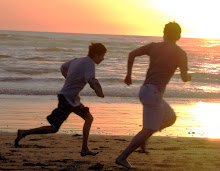
They're friends of the prince, the king's cousin, that wiry, little young man always in a baseball cap. You'll see him at the charity runs waving a sign to start the race, and if you didn't know who he was you'd think, 'how cartoon-like that boy is." But the friends of the prince are another matter. They're serious looking, tall, always striding, and supercilious young men. They make fun of everything. And they are always careful to reinsure in your mind their closeness to the palace. Referring to the prince, they'll say, "Hey, did you hear what he told me last night?" and they'll embroider some story he told them or even if he didn't tell them. Or, they'll say so they can be overheard, "Hey, what about the new Audi? 16 cylinders, that baby really hums." As though it were their car. Everyone has seen the creamy white new Audi, it seems like the prince has a new car every week, but it is more like every month, so to hear this is to hear power itself, to feel the weight of the palace, and the king, himself.
Or, you'll hear one of them say, "Yea, he's invited me down to Marrakech for the weekend. I'll probably go, I don't know."
They drift through the campus with the humid air of priviledge. This is not necessarily how they are one on one, but you rarely find them that way; they're ususually in a group, 4 or 5 boys, and a girl or two. The girls are groupies. Not always, but usually. They're drawn in for entertainment, fodder for a lazy afternoon. "Hey, stupid, get me a bottled water," they'll say. "Hurry." Or, "Let's see more of your tits." And if one of the girls steps out of line, they'll be crushed. If one said, "you know you're like little children. You're bullies of no consequence." Or, "You represent everything I hate about this country," which no girl would ever say, but if she had a certain expression that suggested judgment, or if she didn't respond soon enough to one of their jokes, they might treat her as though she had said, "you represent everything about this country I hate."
But look at that one there, with wavy hair, a head too big for his body, there, the swarthy one sitting on the window ledge outside the little cafe. He's the president of the local charity. He's the last one you would ever put in such a position, but his father was an advisor to Hassan II. He's Mahkzen if there ever were. You see him from time to time alone. He looks at you over the top of his dark glasses. He passes me and he doesn't know why I watch him. He lowers his head in subservience. I don't acknowledge him.
He is especially crude, this one. "I'll rape you," he may tell one of the girls with a curly, wicked smile. "I just might. You better watch it. And if you make fun of my friends, I will rape you."
Meanwhile, they walk to and from class, doling out conversation like acolytes with incense. They're in school to get a wall decoration. They will work for their fathers. Pas de problem. They're the second and third generation. On Ibn Khaldun's clock they are at ten to the hour: their families are crumbling even as they become more powerful. But they have no idea. The world is as bright and sure as 'dandy.' After all, their fathers are all part of the mahzen. Not in the narrow sense of security services, but they're from the great old families, the Fazzies, whom you always see at palace gatherings.
If you watch them moving around the campus, from time to time you may notice someone watching them, in between the pillars, someone who has felt their cruelty, someone watching with both detachment and loathing.
Meanwhile, the middle school teachers are on strike for the next two days. Two days out of 15, they strike. It's gone on for three years.
Meanwhile, you wonder how the despair can be so durable. Ask the imame in Azrou who was arrested after "May 16th" and spent a year in jail. What was his crime? Unlawful assembly. He wears a beard and so he looks the part of the fearful Islamicist. But it's nonsense.
Meanwhile, in back of Azrou there are two palaces. Not villas, palaces. One for each side of the royal family. Or so they say. They are staffed all year round and you would think there would be jobs when the royal family arrives. But no. The royal family always arrives loaded down with staff and belongings.
Meanwhile, the teenage boy, whose father is a travel agent in Fez, hit an old man while driving. The old man died. Nothing happened to the boy. It was an accident, except that the boy had no license; he was driving with friends who were drunk. But the notion is that he paid his way to get off any charges. It doesn't matter what the facts were. Perhaps, it really was an accident, but in the silt of stories about corruption, this is another grain. The little truth is irrelevant. The big truth is too great to acknowledge, to big to see its true size.
Apr 29, 2005

Apr 25, 2005
Stroll
We walked up the side of the volcano. The ferns are just coming back. We got almost to the radar station; two dogs came running down the hill, out through the trees. Barking like we were the devils. We scared 'em back up the hill, turned off, and sat on a rock.
He told me again about the makhzen, the system, how it used to work. The bottom dweller was the mokaddam. The sheikh. He was the tracker. He gave up to the Khalifa or the Kayad, who in turn went to the pasha, who went to the governor, who might, if something was up, call a friend in the palace. Everyone new in town, the mokaddam found out who they were, where they were from.
Still now, you go to town to get a housing permit. They tell you to come back while the mokaddam finds out your particulars. He asks the guards at the residence, or at one of the corporate retreat centers. The guards always know. You don't think they're watching. After all, it's a peephole of a window in the guardhouse at the residence, and what do they do all day? They sit in flimsy card table chairs talking about nothing. Sometimes, you'll see them pray. But they're working all the time. they talk to the cabbies, they watch like hawks at night. American girl has indiscriminate taste for Moroccan men, brings the cabbies up for some inshallah. It all goes to the mokaddam. And then you're a dossier down on the second floor of the police station behind the Cookie Cracque. I still can't figure out the name.
He tells me these things and, of course, what to believe. He's just a student. Still, he seems to know. He tells me people still disappear. Yea, but how do you KNOW that, I ask. Because the place is so matthair thick with rumors, I never quite believe. "I can't tell you," he says. "But they took someone in our family."
"I don't believe it," I say.
"Believe it," he says. And just then two kids passed below us carrying stolen firewood. "All I can tell you is that nothing has really changed except the appearance.
Apr 9, 2005
Woman No. 3
It was late. Everyone yawning.
"And left handed people die sooner than right handed people?" she said to make her point. Incidentally, I'm left handed, and she knows that. The conversation was about biological determinism. "We're just like birds," she went on, talking to her colleague, Barry, who believes that all love is construct. She suspects he's gay by the way. And she went into a long description of women looking for the bird-like red feather in a man, and not just any red feather, but the reddest, deepest hue of red. And that color would signify his ability to break into one her 128 eggs.
"A man just has his sperm, which he's willing to splash out wherever he pleases. It's nothing to him. But we have our eggs."
Barry waved Woman No. 3 aside and went on about how everything he'd ever felt was born out of his family's and society's predelections. "No one can convince me otherwise," he said. "Love is what's taught, not what is felt." Recently, his girl friend arrived from Paris. She wants to get married; he doesn't. He wants her, however he wants her, but not the commitment. Not kids, for sure.
Woman No. 3 had something to say about children as well, but I won't belabor it. "Whenever I go back to Canada," she said. "I just want to leave again. It's too much. My husband, my children, I just want to leave."
She brought out some digestive she'd bought in Italy.
Woman No. 2 by the way is also Canadian. Mary. I took her to Volubilis one day. She loves to Curl; she's on a curling team that curls three times a week in that season. She gets respectable scores; she goes 2nd, which is significant. When she's not curling, she's golfing, or traveling. There's hardly a place she's not been to, a cruise she hasn't taken. She was abused by her only husband 20 years ago. She likes to talk about it. At home, the only other living thing she has is a cat. Not even a plant. We had lunch in the square in Meknes. She asked me questions the way you do with guides. She has spent her life with people leading her around. She doens't like to be alone. She certainly doesn't like to travel abroad without someone at her side.
Woman No. 1 asked me in no uncertain terms to take Woman No. 2 on this adventure. Woman No. 2 is an old Grateful Dead fan. She's a chemistry teacher, and also Canadian. Women No. 3 and No. 1 are very close. They were in American schools together in Maylasia and beyond. Woman No. 1 and No. 2 are also close. I don't know why. Woman No. 3 and No. 2 are not close. They despise each other and sometime I'll tell you about their trip to Marrakech and Merzouga.
But as I say, it was late. Four people in a third story one bedroom apartment, in a small livingroom, big enough for four people, with a fire and a white rug; Miles Davis, a wilting plant, proper lithos and les objets personnelles.
Woman No. 3 is smart. She reads people closely. She is particularly tuned to body language. It is part of her notion of biological determinism. Everything is seduction, fight or flight. But mostly seduction or not. Something caught her mind and she went from anthropology the fact that all these teachers here are losers. She didn't use that word, but that was the word in her mind. There are many good examples to support that argument. Many people here who are lost, who have nowhere else to go. She mentioned several. The psychologist for example, from Boston, who I suspect was done in by The Courage to Heal. By that whole scandal with repressed memory. She's the kind who would have taken on clients and gone along with the fad and then one day been sued. Or forgotten. I could go on about her. You've never met a woman with child who had so little business being a mother. "You want to get rid of him now?" she'll say on the phone after her son has spent the night or been with us for an afternoon. "Shall I come and collect the little savage?" But not said the way you or I might, where the words would be a veneer that you could easily see through, to the love inside. No. See, here, there is no love.
And there are so many other examples.
Woman No. 3 went on. She was pissed that one of the college administrators had called her to account for teaching things not in the curriculum. She'd never been called to account before. "But I'm not like all these other people. These are people with nowhere to go; they have no life. But I can go anywhere I want. I can go to a hundred places; I can go pick up with my family any time I want...."
Morocco is full of contradictions. And it seems everyone who comes here. Weren't we among those people? Didn't she mean us as well?"
B. spoke up. "I don't know what you're saying. But I'm not a loser and I don't count myself among these people you're talking about...." She got up, kissed cheeks, and left.
I stayed on.
(to be continued)
Mar 22, 2005
"Work"
I meet him in Fez. He prefers a little cafe inside the medina. He teaches Arabic Literature and film in Rabat. We talk about the Koran. I ask him about words and phrases, about the difference between haddiths. Occasionally, we talk about broad questions: what does the Koran really say about revenge? kings, women, ghosts?
"God said that if you need witnesses for a trial, you must have two men or one man and two women. Why? Because God understood that women during that time of the month of their menstrations sometimes act a little odd. They forget. If you have two, one can remind the other."
I tell my friend there are women in Berkeley who would behead him if they heard that.
We talk about one of Mohammed's disciples, Awas Ibn Malik, whose teaching, my friend says, is the basis of the Sunni faith in Morocco. "Why? He's the easiest." Compared to say, Wahhabists, who believe that you absolutely must not pray unless you have used water to cleanse yourself. But ibn Malik was a pragmatist. For him, you can simply find a rock, not any rock, not a volcanic rock or one with holes, but a smooth stone and you put it in a corner of your house — not unlike the meteorite in the Kabaa but my friend tells me this is a coincidence, not symbolic — and you rub the stone and then rub your face and hands and the simulation is enough.
Invariably, the conversation returns to the disparity between rich and poor in Morocco. This is the real topic. The Koran is warm-up, two laps around the field. He shakes his head at the way the teachers are treated in local schools. They strike twice a week in Ifrane he tells me. They get low salaries, they're rarely paid on time; no resources for their classrooms. And who is to blame, the rich ministers and members of the assembly. Look at what they're paid; their retirement packages....
"And did you ever wonder what happened to the hospital?"
There is a brand new hospital on the edge of town, once fully equipped. It was supposed to be the seed of a medical school, but never opened. One story is that the university couldn't find enough doctors to come live in Ifrane.
"Do you believe that?" my friend asks.
I don't know what to believe anymore.
Under his smile, his deep faith, my friend seethes. Above all, he resents the rich students he must deal with at the university in Rabat. His patience is tested when he hears how the poor are treated these days.... This is the door to the most sensitive subject of all.
Once, I asked him about the royal linneage, the tie to Mohammed. He took out a piece of paper and wrote Mohammed's name. He drew several lines to suggest a family tree. Under some, he wrote, 'son'. Under others, 'daughter'. Then he crossed out each of the three sons.
"All died," he said. "No heirs. We know that."
He likes to draw diagrams.
Then, he asked me my name. He can never remember it. I told him. He wrote it down as he had written Mohammed. He wanted my children's names. I told him. "And your sons, when they have children what will be their name." Mine, I said. He was nodding all the time. "And when your daughter has children what name will they carry?" I hesitated. "Will they carry your daughter's name?" he asked. " No, I suppose not."
"Exactly," he said. Then, like a math teacher, he tapped both trees with his pen. "You see?"
There is no link, no tie, no line. "It's all a fabrication. No one who knows about Islam believes that. It's for the people, but it's not true."
"You see," he went on, "the only link, the only tie through the Koran, could be through 'good works'." And above his diagram he wrote "work" and underlined it twice. "Good works is the only possible link, " he said, leaning forward because he believes there are spies and informants everywhere and that the people are getting fed up to here again.
Mar 19, 2005
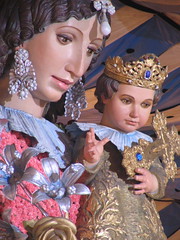
Rustica's Magdalene
Two broads on the wall.
— "Who's the stiff?" I asked.
— "Mags," said the 'tender.
— "She don't look so good."
— "She passed."
— "Still..."
— "Each to his own," he said
and chucked me another.
— "She looks used," I said.
Not like I remember."
— "Whataya expect? She was used."
— "Still.
Mic towled some tumblers.
— "Who was her last?
That's what I want to know."
Mic shook his head.
— "I like the angel better anyway,"
he said.
— "Classly lookin' broad,
good figure," I said.
— "She comes in here from to time.
After hours."
— "Yea?" I said. "I'll wait."
Mar 18, 2005
Mar 14, 2005
Dialogue With Stone
"I had a dream".
Stone didn't reply. She was just happy to be pushed.
"In it I wrote a play, which was not well received by my agent."
So, said Stone. So.
"All I can remember from the dream was the line, 'You can't beat the 20th Century'."
You can't beat it for what, said Stone.
"That's it, I don't know."
Well, why think about it then?
"I'd like to know if there's some message there."
Maybe, you spent enough time beating up the past. Or beating around that bush.
We went on up in silence.
"Do you enjoy being pushed," I asked.
You always ask me that.
"Wouldn't you rather be immovable? After all, that's part of your nature."
But then where would you be?
"Back in Corinth".
Being devious and a trickster? No, you're better here.
And just at that moment we reached the top and I let her go even before I had to and watched her roll down until she was absolutely still.
Mar 13, 2005
On the way to the Falles Festival

Malaga’s odd squalor, condic splendor for slavo tanners,
In the name of sol. Of old and cold. Ravenous for a light.
Bus neighs and quivers, swerves away, north-by-heaven,
To Granada, beyond the coastal range, Allah’s Allah:
Covered in olive oil and trees; corn-rowed hills like heads,
All dead asleep. The land’s labaisse. Labaisse? Hamdullah!
‘While the rest of Europe’: sewerless, lightless, or books,
Flea-bitten, and gray. Rat rich in gothy, goric clamor,
Meanwhile, far above. Al Hambra’s carved white verses,
Curving in the still, of faithfully protractered pools,
The water-master's geometric haven, but always sad...
Never quite Babylon, or Mecca, is it? Fez or goat enough,
Tent enough, Berber strong and warm enough...
Over the pass. My mind is at a run, contemplating El Rio
Guardalmedina; Hannibal’s retreat; the lasting insult
of unremembered dreams; two breasts vibrating,
a student's, rearranging credit cards; my father, forever
shaving in the nude, those bent blue eyes, under the shade
of martini glasses, and eucalyptus, on North Cordoba Drive,
Sounds of pirate masts, reaching, in sargosso’s still —
save for a witch’s crow.
Bus puts shoulders to the road, head swinging under a load.
And suddenly there it is, out of somewhere, baby paradise,
just as it would have been, in 732, spitting images of Atlas,
white caps over old Marakkech, but less rocks here, less
curse, more oranges in the air. But now. Disolve. Latter day,
Rolling through the gates of the city: under car-topped pillars;
Faschisti-taggers and signs of whizi-goths outside the clubs.
Ibn Khaldun's clock strikes twelve... Bus snorts — spooked:
that same scent of shephard's despair... Now where's home?
and the new Almovids whirling in the dust, disoriented,
unfounded. No, this is not a sweet Seville and never was....
Mar 12, 2005
Half faced

The grail’s somber bell strikes 10.
For a blue boy’s Arthur at any age.
We pause at Plaza de la Reina,
St Martin’s all agony, half-faced,
Our traveler backs to the wall,
Go this way, that way, another way.
All dons know their sacred way.
But in the moment all looks lost;
windmill can’t turn, horse won’t budge.
Mar 7, 2005
Truth & Reconciliation
He was from the Truth and Reconciliation Committee: Abdelhay Moudden, a big shouldered man and the academic director at the Center for Cross Cultural Learning in Rabat. He gave a lecture at the university, followed by questions. The biggest question is how the truth — the whole truth about Hassan's II's treachery, what he knew and when he knew it, which may never be known, considering the chaotic and inaccessible state of the national archives — how the truth will affect people's notion of the monarchy? Will this open the door to more democracy or more fundamentalism? Or the military who, you'll remember, staged 3 coup d'etats.
But it was the very last anecdote that caught the ear. He explained that last week he and some of the commissioners had spoken at a school near where the commission meets. At the school he met three 13-year-old girls who asked him about his work: what was he doing? What was this commission looking into? Why? He had never thought of the problem posed by having to explain this kind of work to children. What a fool he had been and suddenly he had a revelation, which was that, of course, this would all have to be explained to people for whom politics is never mentioned. The girls had all seen the commission hearings on TV. What do you remember about it? he asked. Well, they said, they remembered a few individual stories: the one about the man who was arrested while riding on his bicycle and another about a woman weeping for her lost son. He asked them, what do you think we are doing? He knew they had some idea. Just tell me, he said, what comes to mind. They shook their heads. Anything at all, he said, any idea that comes to mind. They shook their heads. And that's when it occurred to him that even having no direct experience in the violations, which may still be going on, they knew instinctively, reflexively that that this was not a subject to know anything about. Politics, he said, is taboo and we are still living in a place and a time when this subject is associated with pain. An association, an NGO, is looking into this matter of how to talk to children; it's called Mountada al Moutana, in Rabat.
Feb 27, 2005
Shutters on the fly

Shutters on the fly, in the wild blue wind,
Striking strange chords through hollow 'crete.
A score for the big uneasy, a ginsome hangover
It was that flippant Y-N oracle three days ago,
But we have a team on it: will there be an Easter?
Or is that it, the 13th month, actuarially speaking.
Not more than a year from June. Which is it,
Feeble mind? Girly-boy Berber without his sheep?
Such stupid things became you faith. Saw layers,
Signs, now messages from a garage boy’s mind?
What possessed you? Well then, you deserve it.
But of course, what to do with the habit,
Hope mind over doubt? But you don’t have it to override....
So now you’re stuck, hopped up on your wait,
Making out.... “Make it a double, please.”
Right old Bill? The G-man behind his desk,
Haunted by the early death of his only G-dad:
A right winger from Maine in the FBI.
But I'm thinkin', I just need that third book.
Then I'll go... 'c’mon, baby, just one time.'
and his was a good mind given to doubt.
In Water Street holes he revived, with 5 Vodka
Tonics and after 2, all neats, he could see light,
‘Though not tonight.... There it is again....
That flat pic will not make me dance.
Shutters on the fly, in the wild blue wind,
Tsunamis roaring down the flue.
Hey, put down that imagination, boy.
Get hold of yourself, ain't no bots in the rain.
Rest easy, girl, there’s more to come.
Feb 24, 2005
Going Toward It
I'm always telling them, you can be anything you want on stage. I reassure them. I explain that Building 17 is freedom's palace if there ever was one. They understand and slowly they're beginning to believe it. The core group gets it; they want more.
Once, I had a warm-up exercise in which the Red people stood perfectly still and silent, while the blue people walked around and said whatever they wanted. Then reverse. I never get involved; I prefer to go around and coach. It's a chance to be a voyeur as well. But this time, since we were short, I played the statue opposite a young actor. This was her first time. She was like a yelping dog around a bear. She backed up and crouched and went into a tirade about her worries, academic and social, but particularly about the theater and here she was taking a real risk by coming and she was afraid, and what was I going to do with her, and how would this all turn out.
We switched roles and I got very close to her, close enough that I could smell smoke in her hair and perfume. It was instantly erotic, being able to talk to her in this way. I whispered in her ear that I wanted her to be a little frightened, I wanted her to take a risk, that was the whole point, to be fearless, I said, and I told her what I had told Marina long ago, one afternoon, on the beach in Malibu. I said to the actor, it's like swimming in the ocean and suddenly here's a set you didn't notice and the waves are too big and too close together to get to the shore, yet the prospect of staying out is frightening, you'll be swept away, you'll be caught by the undertow, and so your instinct is to get in, but you start and the suction is so strong you can't and then you look over your shoulder and there's the wave, gathering up into that marble wall, that lovely, terrifying wall, rising up higher and higher, the marble disolving to black and then finally to deep green, and there you are, in no man's land. Now, you've got to suffer the break and all that boiling white chaos, or else go toward the wave and, just as it breaks, go down and dig your hands into the sand, wait, come up and then swim away from the beach.
And know that as soon as you get to the surface there'll be another wave right there. It will look monstrous and you may have to come up through the kelp, which is heavy and adhesive and you'll have to go down again, and again, and you'll have to go down and really hold on. You may have to do this three or four times, diving and surfacing, and it'll become more and more frightening. You'll begin to doubt. You'll look for help. But there's nobody on the beach and they couldn't hear you anyway.... Eventually, the sets will clear. You'll forget that; but there'll be an opening. "Go toward it," I said, looking at the side of her face, enjoying the role, languishing in the sensualities, going toward the wave, towards her, away from shore, right to the sand, feeling the wave come down like a collapsing building and roll past.
Feb 10, 2005
Feb 1, 2005
The Colonel
http://macnamband.blogspot.com/2004/12/disquieted-americans.html
Did I tell you about meeting the colonel? We met him in the souk in Casablanca. At the Debrghaleff. Down a dark little rabbit run, that ends up in electronics. Here, everyone knows the colonel. He's now a policeman. He invited us to his house. We looked at each other and agreed to go.
He lead us to his car, told us to watch for pickpockets. The car was a shiny blacked-out, black Benz. Inside, you could see it had known better days. The transmission shuddered. Doors didn't open. We drove away.
The colonel stopped by to get pastries. We arrived at his house, an old villa in the California district, which is home to retired military. In the front yard, a Firebird up on chalks. Next to that a rotting garden. The porch, a mess.
We sat down and looked at pictures of the colonel in better days. At Ft. Benning and Ft. Hood. In the same class in war college as Schwartzkoff and the secretary of state. "Oh, I love America," said the colonel. "My first wife was from San Diego." He showed us her picture. She looked like somebody from San Diego: Blonde, dark glasses, a smile. Definitely West Coast.
These days the colonel is in charge of all detectives in Casablanca. Or so he claimed. He loves movies about espionage and international terrorism.
His wife appeared. She brought more pastries. His children appeared. Beautiful children. We talked and talked and finally it was time to go. We went out to the Benz but the tire had gone flat. We walked across the causeway. He walked with us, waited with us, hailed a cab, got us in and away. We promised we would call him, but we haven't yet.
Jan 30, 2005
Jan 23, 2005
The Specialist
In those days the Colonel had other "responsibilities." One was to keep the opposition in line and if you were on his list, he would send his men out to find you. If you were in say, Khouribga, he would send the "specialist". The "specialist" was an anonymous looking little man with unsusually smooth skin. He would arrive at your house at any hour. You were always asleep. Or, you were naked and compromised in your bed. His men would steal into your house and escort him up the stairs right to your room. They would open the door and suddenly here is the "specialist" standing over you. If you didn't wake up by then, he might look at you for a long time and maybe even draw up a chair and sit down next to you and blow smoke at your face until you woke up. "Good evening," he would say in French or Arabic. If he spoke in French he would adopt that culture and he might humililate you verbally for a moment. He might say, "Who is this woman you are sleeping with? Is this your wife or your mistress?" You see and if it was your wife, then she would think you had a mistress. If it was your mistress then you would be on notice. He always knew. He was like a good lawyer, he always knew the answer to his question. Or, he might speak to you in Arabic and he would speak in a low voice and tell you that you were barely goat shit and enough was enough. He was, he said with his left eye fluttering sometimes, finished with your doubts and your fears and whatever reservations you had about the government. He might occasionally also speak in English, if you knew he could not speak it, or Spanish, as a way to test you and he might say, "I'm going to fuck your wife right now in front of you and all my men after me." And if you didn't react that would tell him something and he would go further to find out if you were either ignorant or clever. He would track you down, bring you to ground. Isn't that the expression? and then suddenly he might stand up and leave. He would go down to the car while you got dressed. Or else, if you were naked, he might sit there and watch you get dressed and comment on your body, on your fat or your muscles or lack of them and of course inevitably "your thing" as he called it. How is "your thing" doing these days. And he might even talk to it, and have the guards bring you close so that he could speak directly and at close range, as though it were another person. "I'll bet you know something; and I'll bet you'll talk won't you. You'll tell me what's been going on here. You never lie and I trust you. So don't worry, you'll be taken care of; you don't have to worry. But it's important that you get him to understand."
And then he might look at you. And depending on his mood he might have one his men lean down take you in his mouth. Anything was possible. He might pull out a pair of scissors and snap them open and shut. There were other specialists in those times, and they all used different methods. But the head of specialists, the most feared and the one the colonel handpicked, and some say, trained, for the job, was this one. I have never heard him called by name, only the "specialist." When I asked the colonel, he merely smiled and shook his head. "I never asked," the colonel said to me.
When he was finnished with you, in one way or another, he would go down to the car and wait for his men to bring you down and you would all drive back to Casa. Followed by a second car. He always went in two cars. If you were important he would have you sit in the front seat and he would never stop playing with your mind. He might show you a piece of piano wire he carried in his pocket. He would talk about the g string, and if you were sophistcated, he might make a joke about the double meaning of the G string. Or even the G spot. "I love the G spot," he would say. "I always find it. Women know I will." He would try to get you to relax and then he might slip the G string around you neck and let you ride with it like that for several hours. He could tighten it or not. And so you were always living in the moment. This was his plan, to get you to live in the moment, but of course always a moment of fear. And then at some point he would offer you Moroccan tea. With honey. That was his signature, the honey. That was sign to you; you were now in the hands of an icon, a myth. If you had questions until this moment, then you could relax if only because the truth was out. You are in the hands of the Specialist. And so he would take you to Casa to the colonel's home in the Laya quartier where your experience would begin in earnest....
Jan 16, 2005
Dialogue With Stone
What is that? I asked, seeing something in the distance. Looks like someone. Or is it a shadow? A shadow, said Stone.
— No, it's a person. I can see them quite clearly now.
— Allah's shadow on earth.
— His what?
— caliph.
— How do you know?
No reply. He's like that. Just drifts off. Gets to the punchline and won't tell you. I went back to pushing. We were almost to the top.
— I don't understand these berbers, I said after another long time.
— What's to understand?
— You look in their eyes and.... And....
— Yes, and....
— I see pessemism.
— What did you hope for?
— Some sign of hope. But all I see is pessemism, as though their emotions were very far away, just a glimmer. You hold their faces in your hands and you are watching old ruins, you are looking into their dark tents in the middle of winter.
— They're warriors. Think of their empires. Imagine such a life.
— Yes, I understand and then after the battle, what is there? Only sorrow, for the dead and because the battle is over. Life is hope for another battle.... What was her name, Kareena? The amazon, who smeered her breasts with hennae the night before a great battle. Who drank the blood of her enmey's children....
— Think of the power that might give you.
I look at the stone.
— And what is their culture? I said. Nothing. They have none. They're thieves and cons. But I have this attraction for them.
— They're familiar.
I saw something far away just as we reached the top and the stone went rolling off toward the bottom.
What is that? Another Caliph, perhaps.
Jan 15, 2005
Derbghaleff
2
His undoings were never a mystery to us. We could follow the inevitability like the road to Merzouga, or better the N1, in fact just as he did last March, driving to Casablanca on a whim, obsessed with flash memory, down through the city’s smoggy liver to the under city souk known as the Derbghaleff. When he heard me describe it, he immediately asked for directions, and was insulted when I told him he’d never find it on his own. “I’ll find it,” he said in that awful way he had, as though he were the master of lost and found. This isn’t like God, I said. I will, he insisted, forever impervious to cynicism. Rather than make a game of it, I drew him the best map I could. Useless, of course. He spent hours trying to find the place and finally did what I suggested in the beginning: park, get a taxi.
Derbghaleff appears all of a sudden, in a well-dressed neighborhood. You could mistake it for a vest pocket slum: an unholy akimbo, behind a wall of people, corrugated roofing, wires every which way, flocks of satellite dishes, and the kind of parking attendants you find at the Meadow Lands before a Dallas game. But no, not a slum, it’s the city’s utility drawer. It’s also an economic engine. And if you ever wonder how people survive with 30 percent employment, go there and you’ll see a stage full of entrepreneurial sprites and free-market desperados. Every model of plug, screw, and drill ever made. Up to 10 years ago. Electronica, auto Kasbah, sneaker-rama, crazy Eddie’s jabilyas, from smoothies to roosters, you can find it here. Mile high stacks of old key boards, car stereos, old clothes, cloned copies of replicas, and the usual Berber bric a brac: sconces, rumplestilskin slippers and aluminum-death tea sets. Overhead, the sound of hawkers, hip hopsters, muezzins, and groaning generators. There are upscale shops there as well, the shoes carefully laid out or whatever it is, lingerie, carcasses, silks from West Africa, Quark 6.1 and Photo Shop all on one disk. Although when you get home, likely the registration number is missing or else the disk is no good. But you’re only out $2.
For Eli, Debraheff was a revelation. It was himself as place. You might find an artifact of your soul in Merzouga or in the mountains behind Ismil, even some misquided romantic notion, but not him. His link to eternity was in these cubicle-sized shops that go on and on, and inside the shops, little display cases and littler drawers and inside those ever smaller boxes, until you get down to storage places no bigger than thimbles with tiny hatches. But all places you could hide yourself, be fragmented and compartmentalized as he was. He loved it all, and never saw through it. He didn’t see this particular souk as faux exotic. “Just a lot of shops close together,” I would tell him. “Pickpockets and black market types.”
He smiled dismissively. He was Lawrence of Derbghaleff. This was his desert of melancholy monotony and tribes to drag off across the sun's anvil to Aqaba. Of course, the sensuousness appealed to him, the genuineness of strange strangers rubbing against each other like ants around the cutting board, butting thoraxes down paths wide enough for an eight inch drainage sewer, everyone doing the hopscotch along one side or the other.
He was after Flash memory; another irony, for a man who felt he was losing his memory. One of those little lighter-sized gadgets you stick in a USB port and fill up with pictures, or in his case, articles about the early caliphates. He was fascinated by the work of the fifth-century historian Ibn Hazm, who compiled a list of “Those Among the Caliphs Who Died by Assassination and the Manner in Which They Were Killed.”
He took Fadwa with him. It was before I realized the extent of their relationship. Her parents lived in Casablanca; I thought he was merely giving her a ride. She, as it turned out, had never been to the Derbghaleff, and knew of it only through her maid.
They arrived and were overcome. There was almost too much to see, and too hard to find anything. They spent an entire afternoon drifting from section to section after having gone to every one of the booths in the electronics realm and narrowed the price down to 375 dirham they stopped at one more booth. An older man seemed to be the proprietor. Fadwa asked for flashmemory. The older man was instantly drawn to her and smiled. “So you are Moroccan, and you,” he said looking at Eli, “are….American.”
Eli was bending over watching the assistant who rummaged around, and down and behind and inside the out of sight, the assistant came back with a handful of flash memory containers.
“You’re English,” said the grey haired man. Colonel Chiron.
Eli looked up. “No.”
The colonel put out his hand. “Very glad to meet you. I know your country well.”
Eli was more interested in finding the particular color of flash memory, but the colonel persisted. “Where are you from?”
“The United States.”
“ I know that. But where?”
“California.”
“I was in San Diego. My first wife. We lived in El Cajon.”
“Really.” Said Eli.
“I like blondes, Very beautiful. Always sunburned. Caramel breasted.”
“What did you do there? ” Eli said, not looking up.
“Military. Ft. Benning. Lackland. Camp Pendleton. I went to them all. “
Eli found a color he liked.
“I’m a colonel,” said the colonel. “Intelligence, special forces, ranger training.”
Eli looked up again. “You are a colonel.”
“Not now. Now, I’m a policeman. I am in charge of the inspectors in the city.”
Eli was suddenly interested. The shop owner suddenly appeared, said something to the colonel and took his place behind the display counter.
“Tu veux ca,” he said abruptly to Eli.
Eli was always annoyed to be addressed informally by strangers. “Peut Etre,” he said.
The colonel said something in Arabic’ the shop owner showed deference.
He will give you a good price, said the Colonel.
“How much?” Eli said.
“What do you want to pay?” asked the shop owner, rubbing his fingers together. “Leave a little something for me, and name your price.”
“200 dirham.”
The shop owner smiled and shook his head.
“The art of negotiation is that everyone must be happy,” said the colonel. “This is about friendship not about what you are buying.”
Eli looked at the little plastic totem in his hand. He shook his head, shrugged his shoulders. “Two hundred and fifty dirham.”
“Three hundred and fifty,” said the owner. “I cannot go lower. I need something for myself.
Eli looked at the colonel.
“What does this cost in the US?” said the colonel.
“Well, more.”
“What?”
“Fifty dollars, maybe for this, sixty.”
“So pay $35 and you are ahead and the shop owner is ahead. What’s $10? Don’t let pride destroy the opportunity.”
Eli didn’t quite understand the opportunity but felt the upbraided student. He quickly agreed, paid and put the memory in his pocket.
“Why don’t you come with me?” said the colonel. “I will show you the real Casablanca. But first you come to my house. “
Fadwa frowned, but Eli ever interested in “penetrating the culture” reached over and smoothed her forehead with his thumb. “We’d like that,” he said watching Fadwa. “Wouldn’t we?”
Fadwa looked back and tried to object, told him with her eyes that this was not what she wanted to do, especially considering how little time they had together, and considering that this was not a man’s whose house she would have been interested for any reason.
They walked out of the souk and it was then that Eli realized the colonel, whoever he was, had powers. A man out of nowhere, dressed anonymously, with sunglasses and broad shoulders nodded to the colonel and set out to clear the crowds. The colonel kept looking back at Fadwa who was right behind him. Occasionally, he would take her by the arm and point out something or tell her some anecdote about this shop owner or that. She in turn looked back at Eli, sometimes shaking her head as though to say, why do you do this to me? Eli watched the procession from back, occasionally losing his position. It occurred to him that the colonel’s interest was in Fadwa not himself and he made an effort to get closer to her. Once, the colonel stopped and told Eli to be watch for pickpockets in this particular area, by the clothes thrown on a heap and a smoothie stand.
Eventually, they made their way to the street. The broad shouldered man ran over the median strip and disappeared into a dirt parking lot. A few minutes later, a black Mercedes appeared. The colonel, ever solicitously, guided Eli and Fadwa to the back seat and sat in the front with his man. The car was more run down on the inside than out. The leather was ripped. The windows had been poorly tinted and were so dark that Eli couldn’t see out. Bent cigarette stubs spilled out of the ? on the console between the streets and there was the colonel’s hand, ringed, carefully manicured.
The driver got out of the traffic and headed who know where. At one point the colonel pointed to a street, and then half way down, he knocked on the window with his rings. He got out and returned after five minutes behind bags of pastries.
We arrived at his house in the California district. The black office building of the minerals industry is the landmark...
Jan 14, 2005
Much Worse Than What You've Heard
This is mostly true. He lives in Rabat. I see him occasionally. The other evening I went up to his apartment early. “You don’t mind if I’m wearing my PJs,” he said. They were beige with yellow dots. He also wore an ascot.
“I was ready to hit the silk, myself,” I said. He went out of the room to get beer.
His wife was sitting at her computer. “He’s so glad to have someone to talk to,” she said.
He returned and I told him my need. Election news in the Iraqi newspapers. He nodded but told me his story first. He left the country at 21, returned last year for the first time at 42. There were mortars most nights, explosions from time to time, but he never saw anybody get killed. “It wasn’t bad,” he said. “Not like now.”
He documented the now. “Much worse than you realize. The other day my brother told me that for every incident reported in the press there are ten more. You can’t keep track. It’s happening all the time. We went to the Iraqi embassy yesterday in Rabat. I went to pick up my passport, which I hadn’t had 20 years. They gave my approval in 15 minutes. Anyway, they said, “don’t go. You’d be a fool to step foot in the country. No one is going.”
He went on with his story, how he went to Baghdad a year ago, through Jordan. How the man at the border couldn’t read. “I gave him my passport. He said, what country are you from? This is a Mexican passport, I said.”
“Ah, so you’re from Canada.”
“No, Mexico”
“Mexico-Canada; Canada-Mexico. Same.”
“But they’re not.”
"Finally, he signed the document with a date stamp. That was all. And you wonder how people are coming across the border. Anyway, now the minute you step across, there are people watching. Kidnapping is the most lucrative profession.”
We talked some more and sat down at the computer. We went to Iraq4allnews.com. He went through the headlines, as of 1/14/05.
A scandal involving journalists.
A telecommunications company cheated customers.
Iraqis in Israel will not be allowed to vote.
28 prisoners escaped from Abu Graib prison today.
Few of these stories have bylines or sources or quotes or names.
Iraqis can file absentee ballots in 14 countries. Morocco is not one.
The Patriotic Group of Iraqi tribes asks all tribes in the country to boycott the elections.
American soldiers are selling weapons to insurgents. There is a photograph of a man, supposedly an American soldier about to kneel in a mosque.
“It’s crazy,” says my friend. “All chaos. No one knows anything. How can you know anything from these crazy things? “
One story says there are 700 Muslims in the American army in Iraq.
Fallujans will boycott.
Iraqis in Israel WILL be able to vote.
“You see the contradictions,” my friend said. He read on.
The Iraqi defense minister tells an Egyptian newspaper, Arab Struggle, that the list of candidates is really an Iranian list.
Another poll worker assassinated in Baghdad.
A pundit comments, “The situation now is like a bell signaling the beginning of civil war.”
“My brother tells me there is no electricity, except for perhaps one or two hours a day. And no petrol. Can you imagine in a country with such reserves, no petrol.”
And then a rough translation. “On a diet of strange occurrences every day, one marvels at the mystery itself.”
What does that mean, I asked.
He shook his head and went on. The stories suggest complete chaos. And of course there is no conventional election coverage because few candidates advertise their candidacy. Otherwise they would be killed. On election day you will go to the poll, and be given two pieces of paper. In one, you will find a list of parties that will send members to the general assembly. Pick one party. In the other, you get a list of parties representing your province. In the north, you get 3 pieces of paper, the third for the Kurdish assembly.
More.
Ambassador Negroponte met with the leaders of the Committee of Islamic Scientists. They are Sunni. Their message was ‘give us your timetable for withdrawal and we will vote.” Negroponte filed his report to Washington and apparently the condition was rejected.
The Shiite Counsel of Islamic Revolution, Abdel Azziz Al Hakim (these spellings are on the fly), was quoted to say that even if the Sunnis didn’t vote he would leave seats open for them.
The election counsel would like to make people aware those candidates promising heaven in return for votes should be ignored.
Kurd leader Masood Barazani met with a sheik from one of the Arab tribes in Tikrit. (Which is significant, if true)
Hosni Mubarrek and the Sheik of the Al-Azhar, mosque (founded in 970 AD as an Islamic university and still the fount of Sunni orthodoxy) have been pushing for Iraqis to vote in the election.
He found several other stories. This person killed. Those persons blownup. One after another, stories of chaos.
“And remember for everyone reported, 10,” he said.
“Right.”
“Crazy, huh?”
I had to leave. We went to the door. He said he'd been offered a job in the new government, a financial advisor to the Iraqi president. "I called my brother, I was all happy. He said, if you take it we'll all be killed. That's what they're doing now, they're going after the families...."
Jan 13, 2005
Ballad of a Coco Girl
"He calls us coco girls," she said. She's late 20s, just married, enrapt in Hermes scarves, frankincence and Murr.
What's that mean, I asked.
"Well, you know." She speaks French like a native but her English is patched together. "What you call them? Like call girls."
I was startled.
"They say it. They say we are the president's harem." She shrugged her shoulders. "Can you believe it."
She's smoking furiously.
I can't believe it.
"I told the president I'm leaving, but it's not because they're going to pay me more. I'm leaving because what can I do here? This is... what do you call it? A mad house."
And then she told me many stories from the mad house, about who is the most hypocritical and who is most sexist.
The worst is Dr. X. He came into the communication office one day. A stocky face like a knotted piece of wood. He walked in, hunched over in an overcoat like a character in a Dostoevsky novel. He had an odd bandage on his left nostril. He told one of the cocoa girls that he was in the midst of love making and his "tigress" bit him.
He's in charge of finance. He taught high school chemistry in the Royal school. This is his background in finance. So they say, He came with the president; this is his real background. It is said that he saved the university from financial ruin, which is a trick because under the university's charter the national assembly has the power, and the responsibility, to pay off the university's overages.
Dr. X is well known around campus. He has had a series of affairs with women in the university staff. He is always on the prowl. Several women have considered filing sexual harrassment charges, but they always change their minds. There is just one who may follow through.
Meanwhile, the university is in chaos. Falling enrollment. Teachers stay on average just two semesters. Morale is bad everywhere. The number of students who go on cocaine binges out in the country is rising. Many teachers are teaching outside their area of discipline. The school counsellor seems inept and overwhelmed. Academic pressure is high, expecially for students who are not used to it and who have been pampered. Students write the newspaper regularly complaining about the professors, which could be a reflection either way. Technical people are leaving. Allegations of wasted and misspent monies. The unanimous consensus: very bad management.
Someone told me this is the best university in Africa, which is not true, of course. There are any number of better schools in Egypt and South Africa and probably 3 or 4 other places. But if it is one of the better schools in Morocco, at least, what can one say about higher education? Especially since the graduates of this school are all heading out of the country.
Subscribe to:
Posts (Atom)